

THERMAL ENGINEERING
FOR SPACE APPLICATIONS
Madrid Space offers complete support on thermal control of space applications from “A to Z”: from architecture and high level design, to detailed design, analysis, hardware definition, test definition and execution.
We design and simulate comprehensive thermal solutions for spacecraft and space systems, ensuring optimal performance under the extreme conditions of space. Our expertise guarantees that thermal systems are robust, efficient, and fully aligned with mission objectives, from Low Earth Orbit to deep-space ventures.
Our thermal engineering services include:
-
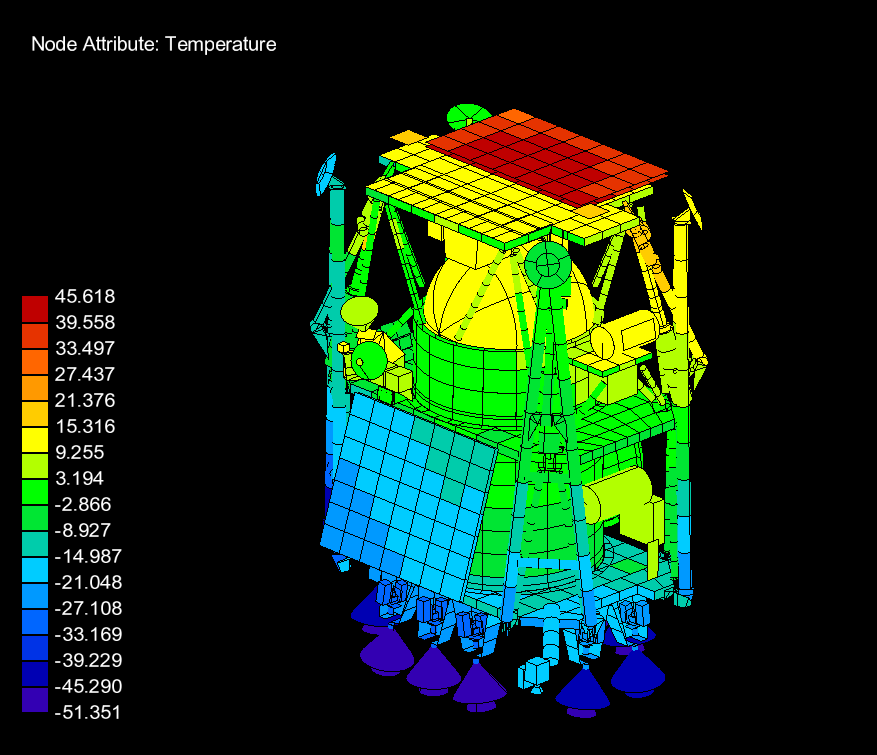
We create accurate thermal models to predict how every part of your spacecraft will behave under all conditions—whether in orbit, during launch, or in extreme environments. Our analyses cover electronics, structures, propulsion systems, solar panels or mechanisms among others, ensuring your equipment stays safe and performs reliably.
Benefits for you:
Identify and solve thermal risks before building hardware
Ensure mission success in extreme conditions, from cryogenic cold to intense solar heat
Reduce costly redesigns and test iterations
Technical details
Geometrical Mathematical Model (GMM) and Thermal Mathematical Model (TMM) creation for steady-state and transient conditions
In-orbit heat flux calculation and full thermal analysis
Reduced thermal models creation and correlation with detailed models and test results
Modeling of all kinds of spacecraft equipment or subsystems: electronics, antennas, structures, propulsion systems, solar panels, mechanisms
Experience with extreme scenarios: from cryogenic environments to thermal environments at 0.25 AU from the Sun
Geometrical Mathematical Model (GMM) and Thermal Mathematical Model (TMM) creation for steady state and transient conditions.
In-orbit heat fluxes calculation and complete thermal analysis
Reduced thermal models creation and correlation with detailed models and with tests results
Modelization of any kind of equipment or subsystem on a satellite or a launcher: electronics equipment, antennas, structures, propulsion systems, solar panels, mechanisms…
Experience with extreme scenarios: from cryogenic environments to thermal environments at 0.25AU from Sun
-
We design and define reliable thermal hardware solutions that keep your spacecraft within safe temperature limits throughout all mission phases. From passive to active thermal control, we ensure each component is optimized, integrated, and ready for qualification and flight.
Benefits for you:
Ensure thermal stability and reliability of critical equipment
Select the right hardware early, reducing redesign and qualification risks
Seamless integration with spacecraft and test environments
Technical details:
Definition of hardware for thermal control: Multi-layer insulation (MLI), heat pipes, Thermo-electric coolers (TECs), heaters, passive/active thermal devices…
Design of Ground Support Equipment (GSE) for thermal purposes
-
We support and execute thermal test campaigns to validate your design and ensure your system performs as expected before flight. Our engineers work alongside your team—on-site or remotely—to reduce risks, streamline testing, and build confidence in your thermal solution.
Benefits for you:
Verify thermal performance before launch
Reduce qualification risks and late design changes
Gain confidence through data-backed validation
Technical details:
Definition and execution support of thermal test campaigns
On-site and remote support during thermal testing activities
Correlation of thermal models with test data from Thermal Balance (TB) and Thermal Vacuum (TV) campaigns
Support to model validation and refinement based on test results
-
We provide dedicated test capabilities to accurately measure the thermal conductivity of materials used in space applications. This allows you to validate material performance early and reduce uncertainty in your thermal design.
Benefits for you:
Gain reliable material data for accurate thermal models
Reduce design margins and improve thermal predictions
Support qualification of non-standard or novel materials
Our test bench can be used to measure thermal conductivity of non-normalized samples with a size of up to 25cm x 25cm and an approximate weight of aroung 1kg
-
We simplify the procurement of thermal hardware by connecting you with a trusted network of qualified suppliers. This ensures reliable components, shorter lead times, and a smoother path from design to integration.
Benefits for you:
Reduce procurement effort and schedule risks
Access proven and space-qualified thermal hardware
Ensure consistency between design and delivered hardware
Technical details:
Procurement support for thermal hardware including Multi-Layer Insulation (MLI), thermal straps, heat pipes, and related components
Access to a wide network of qualified thermal hardware suppliers
Support to supplier selection, technical alignment, and procurement process


EQUIPMENT, INSTRUMENTS & SUBSYSTEMS HERITAGE
Madrid Space has extensive experience in the thermal analysis and simulation of a wide range of space systems and mission profiles, including:
Complete Satellite Platforms (100kg+), LEO, GEO Interplanetary Probes
Optical instruments: Telescopes, Cameras (IR, VIS…), Optical Benches
CFRP Deployable Structures
Electronics (within complete unit boxes and through complex installations)
Antennas and Reflectors
Radars
Solar Arrays
Optical Components: Sun Sensors, Star Trackers
Thrusters
Cryogenic Applications
DESIGN & CO-ENGINEERING
Heaters and EEE Parts Definition
MLI Definition and Design
Dissipators Design
Radiators Definition
Electronics Mechanical Structures Design
Thrusters

Software We Use
-
ESATAN-TMS®
Systema-Thermica®
Altair® Optistruct®
-
Altair® Hypermesh/Optistruct®
-
OpenFOAM
Altair® AcuSolve®
-
SolidWorks®
If you use any other software, let us know